Hospital Technology Strategy & System Integration Specification

Client: Provincial Healthcare Organizations (Alberta, Canada)
Services: Technology Strategy | Master Systems Integration | Smart Hospitals | Digital Transformation
The Opportunity
Healthcare organizations across Canada are investing billions of dollars in new hospital developments and facility expansions. While these projects present an opportunity to modernize operations and improve patient experiences, they also introduce significant complexity.
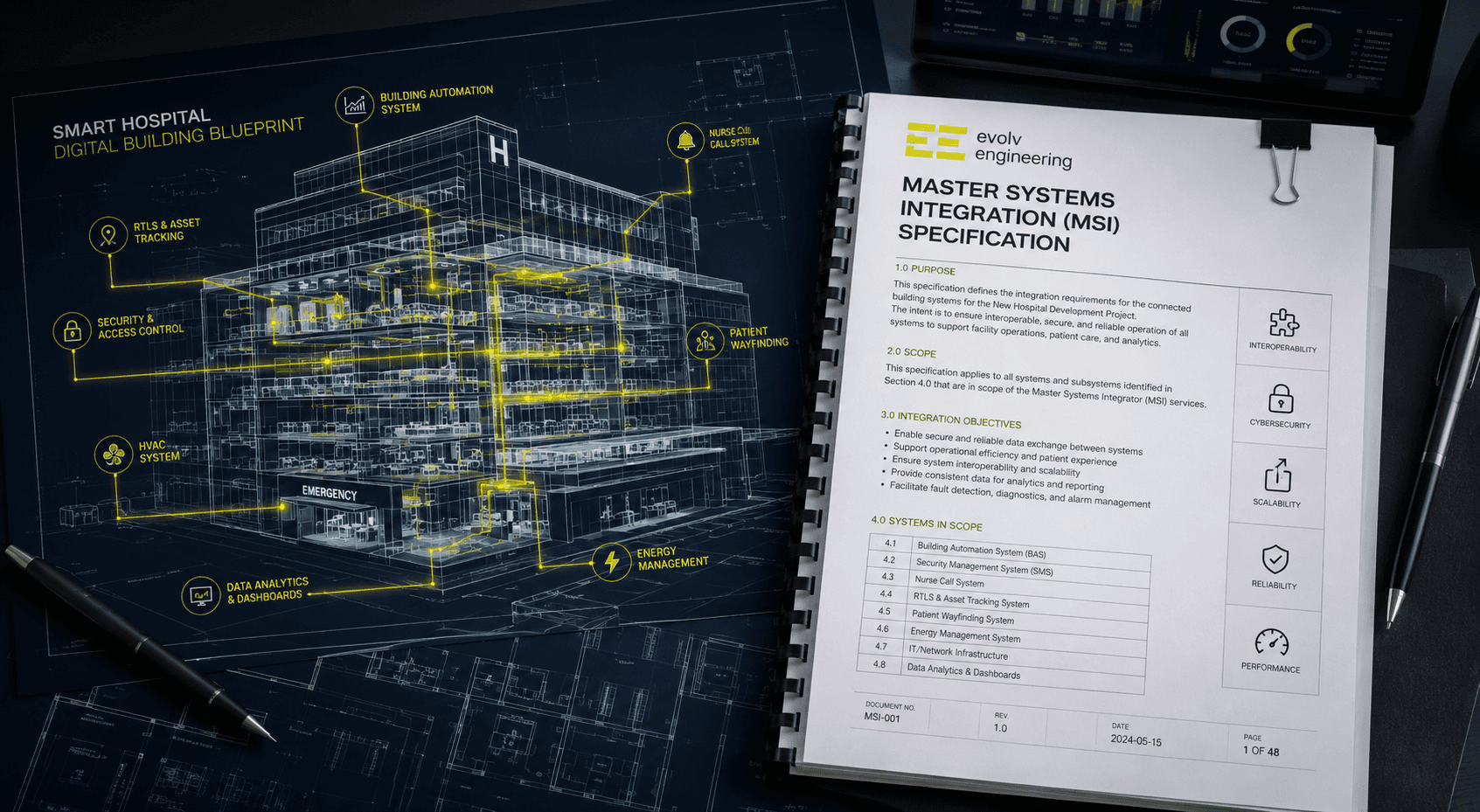
Modern hospitals rely on hundreds of interconnected systems, including building automation, security, wayfinding, RTLS, nurse call, patient transport, environmental monitoring, and analytics platforms. Without clear integration requirements, these systems have historically been designed and procured independently, making it difficult to deliver the seamless digital experiences and operational efficiencies envisioned by today's clients.
Evolv Engineering worked as part of a multidisciplinary project team supporting the planning and design of three major healthcare developments across Canada. A key challenge on each project was ensuring that new facilities could integrate with existing hospital infrastructure while establishing a roadmap for future modernization.
Our Approach
The engagement for each project began with stakeholder workshops to understand operational challenges, strategic objectives, technology aspirations, and future-state visions for each facility. These discussions were translated into detailed use cases that defined how technology should support patient care, building operations, staff workflows, and facility management.
Building on this foundation, Evolv developed integration specifications and technical requirements governing how systems would communicate, exchange data, and support desired outcomes. The work included:
Technology visioning and use-case development
Master Systems Integration (MSI) specifications
Building automation integration requirements
Interoperability and middleware recommendations
Technology standards and modernization planning
Functional testing, commissioning and integration validation procedures
Particular attention was given to ensuring compatibility between new developments and existing hospital systems, helping reduce implementation risk and support long-term scalability.
Results & Impact
The resulting technology strategies, use cases, and integration specifications are now guiding these three healthcare projects currently under development.
Key outcomes included:
Clearly defined digital building and smart hospital use cases
Standardized integration requirements across project stakeholders
Reduced risk associated with system interoperability
Formal testing and validation procedures for integrated systems
Technology modernization roadmaps aligned with operational goals
Improved coordination between consultants, contractors, vendors, and owners
The specifications established a framework to help ensure technology investments deliver measurable operational and patient-focused outcomes.
Key Insight & Why It Matters
The most successful smart hospital projects do not start with technology; they begin with a clear understanding of operational objectives, patient needs, and desired outcomes. Technology becomes significantly easier to specify, integrate, and commission when stakeholders first agree on what success looks like.
Historically, building systems were designed and installed in isolation. Today, organizations increasingly expect technology platforms to work together to support advanced operational workflows, analytics, automation, and digital experiences. Defining use cases early in the design process helps avoid costly redesigns, integration challenges, and missed opportunities later in construction.
This shift has created a growing need for independent technology advisors and Master Systems Integrators capable of coordinating multiple stakeholders and ensuring systems function as a cohesive ecosystem rather than a collection of disconnected technologies.
While these projects focused on healthcare facilities, the same challenges exist across commercial real estate, higher education, airports, industrial facilities, and other complex environments. As buildings become increasingly connected, the technology advisor and Master Systems Integrator continues to become more prevalent.